








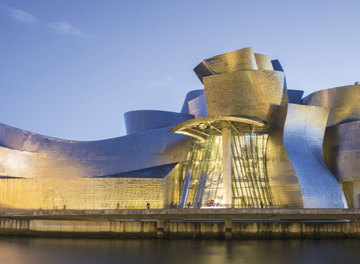
by Nate Berg / © 2025, Fast Company. Mansueto Ventures, LLC. Distributed by Tribune Content Agency, LLC.
29
For an architect whose name and work have become known all over the world, Frank Gehry’s buildings are about as far from the mainstream as one can get. Bent, curved and clad in shiny metal, the most famous buildings by Gehry, who died last [December], are also the most improbable.
Coming up with the flamboyant designs for landmark buildings like the Guggenheim Museum in Bilbao and the Walt Disney Concert Hall in Los Angeles was only part of what made Gehry one of the most successful and celebrated architects in American history. Just as impressive are the ways Gehry helped explore and expand the architecture technologies used to actually build those swooping designs.
A pioneer
Gehry worked for decades to advance new technologies that radically changed how architects work. Despite claiming a near incomprehension of computers, Gehry was one of the earliest architects to experiment with and embrace computer-aided design approaches, like digitizing designs from concept to construction through building information modeling [BIM]. These are now standard practices in the world of architecture, but when Gehry and his firm started applying these approaches, it was uncharted territory.
The breakthrough for Gehry came after his firm won a commission to design a large pavilion for the 1992 Olympics in Barcelona, [Spain]. Gehry, a sculptor at heart, designed a massive abstract fish to be built using stainless steel mesh panels. Translating the design concept into a buildable set of two-dimensional blueprints proved complicated. A contractor tried to build a mockup of the project six times but couldn’t get it right.
So Gehry’s team found a solution in a software tool developed by an aerospace manufacturer. Creating an advanced 3D model of the project allowed Gehry and his firm to more clearly communicate the precise shapes and curves of his design to the builders and contractors on the construction site. The project was completed on time and on budget.
...
Visit Fast Company online.